
Economic Cycle
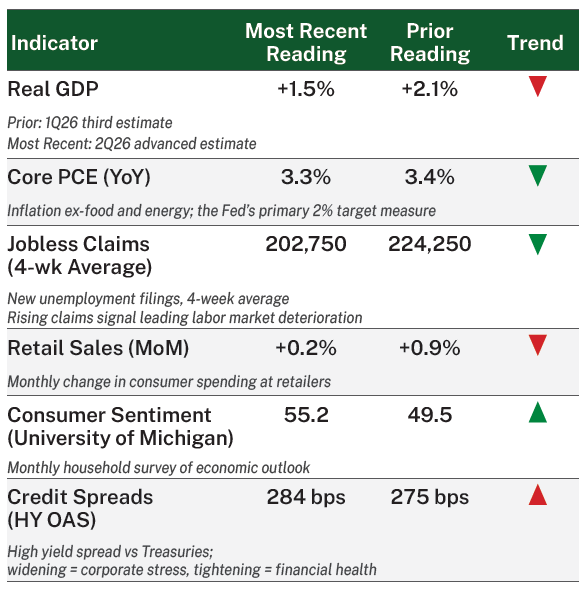
The U.S. economy remained on solid footing through July as continued business investment, supported in part by ongoing spending on artificial intelligence infrastructure, remained an important source of growth. Consumer spending also proved resilient, although households have increasingly relied on a multi-year low savings rate to help support spending, while the labor market remained healthy, with layoffs and new unemployment claims continuing to run at relatively low levels.
Inflation likewise continued to move in the right direction, although renewed conflict in the Middle East served as a reminder that geopolitical events can quickly influence energy prices and the near term inflation outlook. Despite those uncertainties, the broader economic backdrop continues to point toward a resilient expansion supported by continued capital investment, a stable labor market, and gradually moderating inflation.
Equity Markets
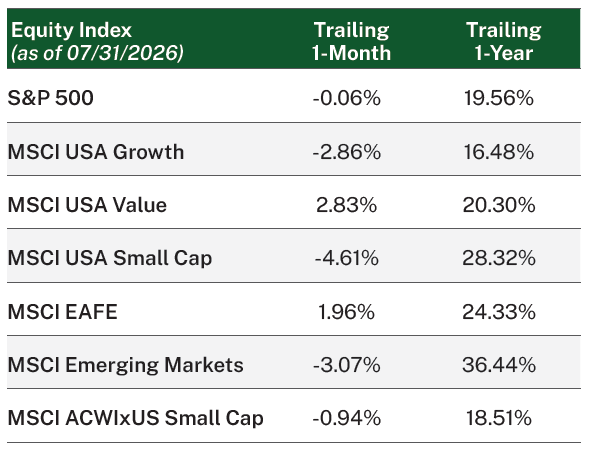
U.S. large cap equities finished little changed in July, but the headline return masked meaningful shifts beneath the surface. Value stocks modestly outperformed growth, supported in part by Energy, the market’s strongest performing sector, as renewed conflict in the Middle East pushed oil prices higher. International equities also continued to outperform U.S. stocks, extending one of the year’s most notable market trends.
Within technology, leadership continued to evolve. Several of the year’s strongest performers across semiconductors and AI infrastructure, particularly memory-related companies, gave back a portion of their outsized gains, while software stocks rebounded. Artificial intelligence remains one of the market’s defining long term investment themes, but recent performance is a reminder that leadership within the AI ecosystem will likely continue to evolve.
Fixed Income Markets
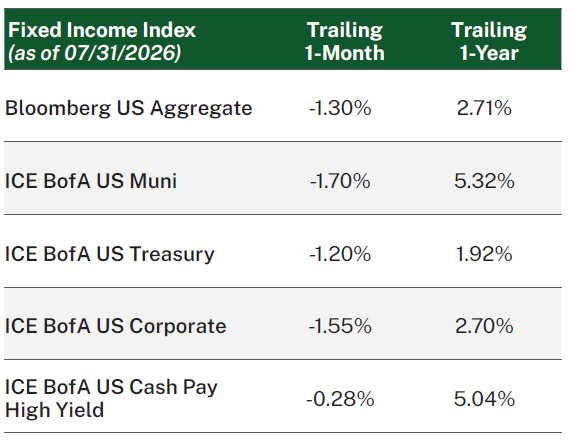
Fixed income markets declined in July as rising Treasury yields weighed on returns across most sectors. Although the Federal Reserve left interest rates unchanged, its unusually divided vote and cautious stance toward inflation reinforced uncertainty surrounding the path of monetary policy. Combined with renewed volatility in energy prices following developments in the Middle East, investors continued to push back expectations for near term rate cuts.
Although higher interest rates pressured bond prices during the month, they also continue to provide investors with a more attractive level of income than has been available for much of the past decade. High yield bonds modestly outperformed investment grade corporates as their shorter duration helped offset the impact of rising Treasury yields, while healthy corporate fundamentals continued to support credit markets more broadly.
Our Perspective
July served as a reminder that even during strong bull markets, leadership beneath the surface can change quickly. The AI investment cycle continues to support both the economy and corporate earnings, yet investors have become increasingly discerning about which companies are most likely to generate attractive long term returns from that investment. As a result, leadership has begun to broaden across sectors, styles, and regions even as artificial intelligence remains the market’s dominant secular theme.
Periods like these often feel uncomfortable because market leadership changes quickly, but they also reinforce the value of maintaining a diversified portfolio. While short term sentiment will likely continue to shift alongside earnings reports, geopolitical developments, and monetary policy expectations, long term investment success remains driven by owning high quality businesses capable of creating value across a variety of market environments.
Monthly Recommendation
Originally published nearly 30 years ago, The Millionaire Next Door by Thomas J. Stanley and William D. Danko remains one of the most influential books on building lasting wealth. Rather than focusing on flashy investment strategies or overnight success, the authors reveal the surprisingly common habits shared by financially successful individuals: living below their means, saving consistently, and making disciplined long-term decisions. Backed by extensive research and real-world examples, the book challenges many conventional assumptions about wealth and success. For anyone interested in personal finance or the behaviors that underpin long-term financial independence, it remains a timeless and worthwhile read.
Indicator Sources: Bureau of Economic Analysis (BEA) — Real GDP estimate & Core PCE (bea.gov / fred.stlouisfed.org) | Department of Labor (DOL) Jobless Claims (fred.stlouisfed.org) | Census Bureau Retail Sales (census.gov) | University of Michigan Surveys of Consumers (sca.isr.umich.edu) | ICE BofA High Yield Option-Adjusted Spread (OAS) (fred.stlouisfed.org).
Index Disclosures: Unless otherwise noted, index returns do not reflect any fees or expenses and are provided by Morningstar, Inc. Index data referenced herein is the property of each index sponsor (S&P Dow Jones Indices LLC, a division of S&P Global Inc. (“S&P”), Bloomberg Finance L.P. (“Bloomberg”), ICE Data Indices, LLC (“ICE Data”), and MSCI), their affiliates (“Index Sponsors”) and/or their third-party suppliers and has been licensed for use by Manning & Napier. The Index Sponsors and their third-party suppliers accept no liability in connection with its use. Data provided is not a representation or warranty, express or implied, as to the ability of any index to accurately represent the asset class or market sector that it purports to represent and none of these parties shall have any liability for any errors, omissions, or interruptions of any index or the data included therein. For additional disclosure information, please see: https://go.manning-napier.com/benchmark-provisions. See next page for index definitions.
All investments contain risk and may lose value. This material contains the opinions of Manning & Napier, which are subject to change based on evolving market and economic conditions. This material has been distributed for informational purposes only and should not be considered as investment advice or a recommendation of any particular security, strategy or investment product. Information contained herein has been obtained from sources believed to be reliable but not guaranteed.
The S&P 500 Total Return Index is an unmanaged, capitalization-weighted measure comprised of 500 leading U.S. companies to gauge U.S. large cap equities. The index accounts for the reinvestment of regular cash dividends, but not for the withholding of taxes. The MSCI USA Value Index is designed to measure large and mid-cap US securities exhibiting overall value style characteristics. The MSCI USA Growth Index is designed to measure large and mid-cap US securities exhibiting overall growth style characteristics. The MSCI USA Small Cap Index is designed to measure the performance of the small cap segment of the US equity market. The index represents approximately 14% of the free float-adjusted market capitalization in the US. The MSCI EAFE Index is a free float-adjusted market capitalization index designed to measure large and mid-cap representation across 21 Developed Markets countries (excluding the U.S. and Canada). The MSCI Emerging Markets Index is a free float-adjusted market capitalization index that is designed to measure equity market performance of emerging markets and consists of 24 emerging market country indices outside the U.S. The MSCI ACWI ex USA Small Cap Index is designed to measure a small cap representation across 22 of 23 Developed Markets countries (excluding the U.S.) and 24 Emerging Markets countries. MSCI indices are denominated in U.S. dollars, returns are net of withholding taxes, and they assume daily reinvestment of net dividends thus accounting for any applicable dividend taxation. The Bloomberg U.S. Aggregate Bond Index is an unmanaged, market-value weighted index of U.S. domestic investment- grade debt issues, including government, corporate, asset-backed, and mortgage-backed securities, with maturities of one year or more. Index returns provided by Intercontinental Exchange (ICE). The ICE Bank of America (BofA) U.S. Municipal Securities Index tracks the performance of U.S. dollar denominated investment grade tax-exempt debt publicly issued by U.S. states, territories, and their political subdivisions. Qualifying securities must have at least one year remaining term to final maturity, at least 18 months to final maturity at the time of issuance, a fixed coupon schedule and an investment grade rating. The ICE BofA U.S. Treasury Total Return Index is an unmanaged index that measures the performance of U.S. dollar-denominated, fixed-rate securities issued by the U.S. Treasury across all maturities. The ICE BofA U.S. Corporate Total Return Index is an unmanaged index that measures the performance of U.S. dollar-denominated, investment-grade, fixed-rate corporate debt publicly issued in the U.S. domestic market. The ICE BofA U.S. Cash Pay High Yield Index tracks the performance of U.S. dollar denominated below investment grade corporate debt, currently in a coupon paying period, issued in the U.S. domestic market. Qualifying securities must have at least one year remaining term to final maturity as of the rebalancing date, at least 18 months to final maturity at the time of issuance, a fixed coupon schedule, and a minimum amount outstanding of $250 million.
Morningstar, Inc. is a global investment research firm providing data, information, and analysis of stocks and mutual funds. © Morningstar, Inc. 2026. All Rights Reserved. The information contained herein: (1) is proprietary to Morningstar and/or its content providers; (2) may not be copied, adapted or distributed; and (3) is not warranted to be accurate, complete or timely. Neither Morningstar nor its content providers are responsible for any damages or losses arising from any use of this information, except where such damages or losses cannot be limited or excluded by law in your jurisdiction. Past financial performance is no guarantee of future results.