
Economic Cycle
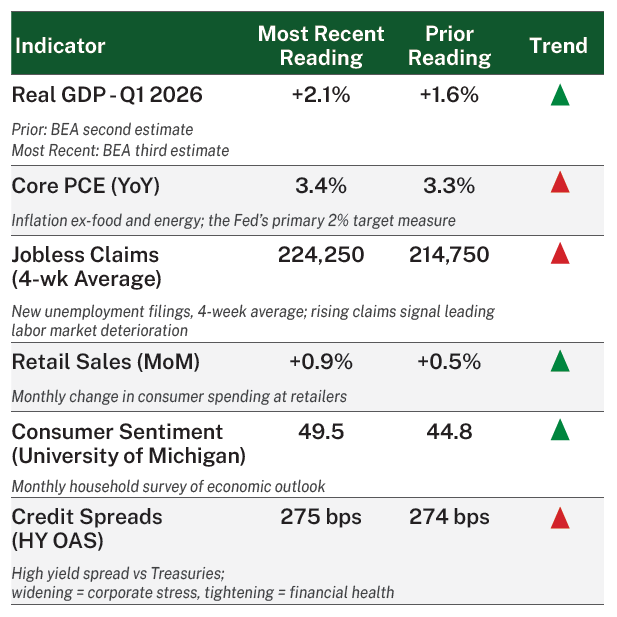
The AI investment cycle continued to drive the economy forward in June, with first quarter GDP growth recently revised upward and corporate profits growing at an exceptional pace. That momentum was reinforced by welcome progress toward ending the war with Iran, a development that carries positive implications for both growth and inflation. The labor market remains supportive as well, with both hiring and layoffs staying low.
Despite those signs of stability and strength, consumers’ income growth has not kept pace with their spending, particularly after adjusting for inflation, and the savings rate has fallen to levels seldom seen outside of recessions, a dynamic worth watching closely. That said, a widening K-shaped dynamic defining the economy and consumer makes this a more nuanced story than the aggregate numbers alone suggest.
Equity Markets
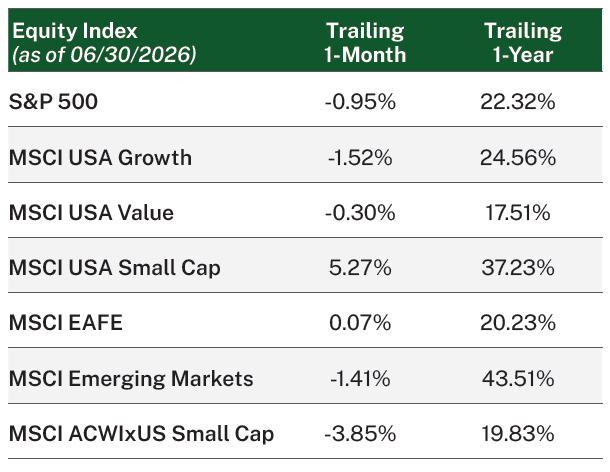
U.S. large cap equities ended June only slightly in the red, as a strong final week pared back a sharper decline earlier in the month. That volatility reflected significant dispersion within the AI trade itself. Hyperscalers, the mega cap technology companies funding and building AI data centers, lagged meaningfully alongside software and other names viewed as vulnerable to AI driven disruption. Meanwhile, companies supplying that buildout, including memory chip makers and some industrials, posted strong gains.
U.S. large cap stocks lagged small caps, which rallied as progress toward peace in the Iran war propelled hopes for a broader cyclical recovery. International developed markets were roughly flat, while emerging markets lagged.
Fixed Income Markets
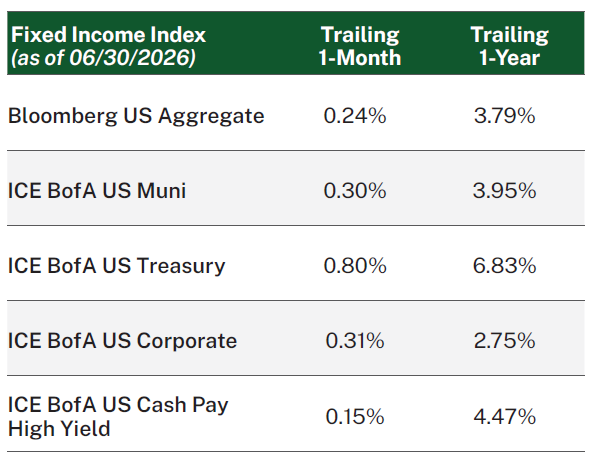
Fixed income markets posted broadly positive returns in June despite a more hawkish tone from the Fed. At his first meeting as Chair, Kevin Warsh held rates steady but dropped language pointing toward future cuts, and markets now largely expect policy rates to remain unchanged for the rest of the year, with even the possibly of a hike. Treasuries and investment grade corporates still gained modestly, as easing oil prices following the Iran ceasefire helped offset the inflation concerns a hawkish Fed might otherwise have stoked.
Municipals were the standout performer, supported by favorable technicals and continued demand for tax-exempt income, while high yield also posted a positive month even as spreads widened slightly. The market’s resilience despite the Fed pivot suggests investors are looking past the near-term policy stance toward the eventual disinflationary effect of lower energy prices.
Our Perspective
We’ve arrived at an interesting inflection point halfway through 2026. The AI trade has driven nearly every asset class meaningfully higher year-to-date, while the market has also never peaked in June, suggesting that history is on its side going into the second half. At the same time, question marks remain around the path forward for the chipmakers that have driven recent gains, as the trajectory for compute pricing – which has skyrocketed against a backdrop of soaring demand and not enough supply – is uncertain to say the least.
As a result, semiconductor companies, especially memory stocks, have gone parabolic this year, with both retail and institutional investors heavily exposed to the industry in aggregate. That kind of positioning warrants caution, although there’s little evidence of weakening near-term fundamentals. The hyperscalers, meanwhile, are trading at decade-low relative P/Es versus the S&P 500, largely due to skepticism about capex ROI. These companies didn’t get to be the most dominant in history by accident, however, and the book is yet to be written on how this investment cycle will ultimately pan out for the companies and their investors.
Monthly Recommendation
Morning Brew Daily podcast is one of the easiest ways to stay current on the latest business, economic, and market news without adding another lengthy read to your day. In roughly 20 to 30 minutes, hosts Neal Freyman and Toby Howell break down the biggest headlines with a conversational style that is both informative and entertaining. Whether they’re covering inflation, earnings, AI, or unexpected trends shaping the economy, the podcast delivers smart analysis with just the right amount of humor. For investors and anyone looking to make sense of a rapidly changing world, Morning Brew Daily is well worth adding to your daily routine.
Indicator Sources: Bureau of Economic Analysis (BEA) — Q1 Real GDP estimate & Core PCE (bea.gov / fred.stlouisfed.org) | Department of Labor (DOL) Jobless Claims (fred.stlouisfed.org) | Census Bureau Retail Sales (census.gov) | University of Michigan Surveys of Consumers (sca.isr.umich.edu) | ICE BofA High Yield Option-Adjusted Spread (OAS) (fred.stlouisfed.org).
Index Disclosures: Unless otherwise noted, index returns do not reflect any fees or expenses and are provided by Morningstar, Inc. Index data referenced herein is the property of each index sponsor (S&P Dow Jones Indices LLC, a division of S&P Global Inc. (“S&P”), Bloomberg Finance L.P. (“Bloomberg”), ICE Data Indices, LLC (“ICE Data”), and MSCI), their affiliates (“Index Sponsors”) and/or their third-party suppliers and has been licensed for use by Manning & Napier. The Index Sponsors and their third-party suppliers accept no liability in connection with its use. Data provided is not a representation or warranty, express or implied, as to the ability of any index to accurately represent the asset class or market sector that it purports to represent and none of these parties shall have any liability for any errors, omissions, or interruptions of any index or the data included therein. For additional disclosure information, please see: https://go.manning-napier.com/benchmark-provisions. See next page for index definitions.
All investments contain risk and may lose value. This material contains the opinions of Manning & Napier, which are subject to change based on evolving market and economic conditions. This material has been distributed for informational purposes only and should not be considered as investment advice or a recommendation of any particular security, strategy or investment product. Information contained herein has been obtained from sources believed to be reliable but not guaranteed.
The S&P 500 Total Return Index is an unmanaged, capitalization-weighted measure comprised of 500 leading U.S. companies to gauge U.S. large cap equities. The index accounts for the reinvestment of regular cash dividends, but not for the withholding of taxes. The MSCI USA Value Index is designed to measure large and mid-cap US securities exhibiting overall value style characteristics. The MSCI USA Growth Index is designed to measure large and mid-cap US securities exhibiting overall growth style characteristics. The MSCI USA Small Cap Index is designed to measure the performance of the small cap segment of the US equity market. The index represents approximately 14% of the free float-adjusted market capitalization in the US. The MSCI EAFE Index is a free float-adjusted market capitalization index designed to measure large and mid-cap representation across 21 Developed Markets countries (excluding the U.S. and Canada). The MSCI Emerging Markets Index is a free float-adjusted market capitalization index that is designed to measure equity market performance of emerging markets and consists of 24 emerging market country indices outside the U.S. The MSCI ACWI ex USA Small Cap Index is designed to measure a small cap representation across 22 of 23 Developed Markets countries (excluding the U.S.) and 24 Emerging Markets countries. MSCI indices are denominated in U.S. dollars, returns are net of withholding taxes, and they assume daily reinvestment of net dividends thus accounting for any applicable dividend taxation. The Bloomberg U.S. Aggregate Bond Index is an unmanaged, market-value weighted index of U.S. domestic investment- grade debt issues, including government, corporate, asset-backed, and mortgage-backed securities, with maturities of one year or more. Index returns provided by Intercontinental Exchange (ICE). The ICE Bank of America (BofA) U.S. Municipal Securities Index tracks the performance of U.S. dollar denominated investment grade tax-exempt debt publicly issued by U.S. states, territories, and their political subdivisions. Qualifying securities must have at least one year remaining term to final maturity, at least 18 months to final maturity at the time of issuance, a fixed coupon schedule and an investment grade rating. The ICE BofA U.S. Treasury Total Return Index is an unmanaged index that measures the performance of U.S. dollar-denominated, fixed-rate securities issued by the U.S. Treasury across all maturities. The ICE BofA U.S. Corporate Total Return Index is an unmanaged index that measures the performance of U.S. dollar-denominated, investment-grade, fixed-rate corporate debt publicly issued in the U.S. domestic market. The ICE BofA U.S. Cash Pay High Yield Index tracks the performance of U.S. dollar denominated below investment grade corporate debt, currently in a coupon paying period, issued in the U.S. domestic market. Qualifying securities must have at least one year remaining term to final maturity as of the rebalancing date, at least 18 months to final maturity at the time of issuance, a fixed coupon schedule, and a minimum amount outstanding of $250 million.
Morningstar, Inc. is a global investment research firm providing data, information, and analysis of stocks and mutual funds. © Morningstar, Inc. 2026. All Rights Reserved. The information contained herein: (1) is proprietary to Morningstar and/or its content providers; (2) may not be copied, adapted or distributed; and (3) is not warranted to be accurate, complete or timely. Neither Morningstar nor its content providers are responsible for any damages or losses arising from any use of this information, except where such damages or losses cannot be limited or excluded by law in your jurisdiction. Past financial performance is no guarantee of future results.